
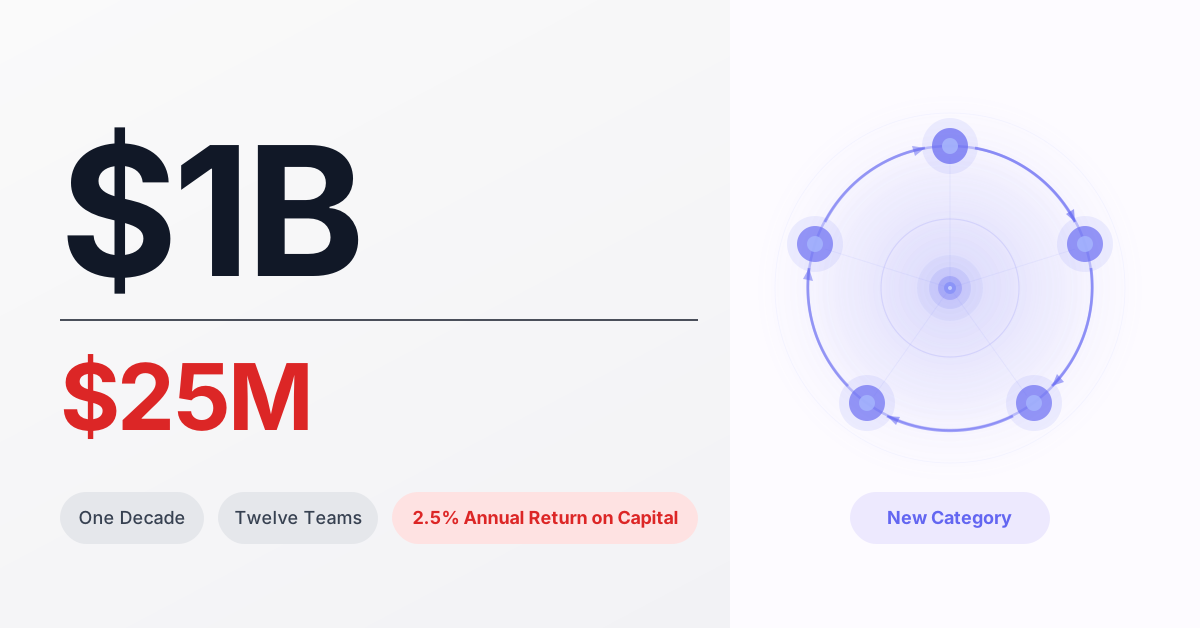
A Billion-Dollar Lesson
The idea was straightforward. A shared workspace for buyers and sellers. Content in one place. Clear next steps. A mutual action plan both sides could operate against.
The problem was visible. The solution looked obvious.
Top-tier investors agreed. Bessemer Venture Partners, CRV, Matrix Partners, Stripe, Y Combinator, Craft Ventures, NFX—they all funded it. Recapped, Accord, Aligned, Trumpet, GetAccept, Dock, DealHub. Over a dozen startups raised well over $100 million to pursue the same thesis. The founders were strong. The customers were real. The engagement was measurable.
The incumbents agreed too. Salesforce acquired Quip for $750 million and positioned it as collaborative deal workspaces inside Sales Cloud. HubSpot launched native deal rooms.
By every intuitive signal, the next major B2B sales category was ready to explode.
It didn’t:
- GetAccept. Founded 2015, backed by Bessemer, eleven years in market. No Series C.[1]
- Accord. Raised $17 million from Stripe and Matrix Partners. No new round in three years.[2]
- Recapped. Raised from CRV. $1.8 million in annual revenue after six years.[3]
- Journey.io. Acquired at $18,000 in monthly recurring revenue. Not $18 million. Eighteen thousand.[4]
- Quip. Salesforce’s $750 million bet on this exact category. Effectively sunset by 2023.[5]
A dozen teams. A decade of iteration. A billion in investment. Combined annual revenue across the entire category is roughly $25 to $30 million.[6]
That’s a 2.5% annual return on investment, assuming the companies were 100% profitable.
The only outlier is DealHub: $62 million. But DealHub is a CPQ platform. The deal room is a tab inside it. Which is, itself, the answer.
This is not a category on the verge of a breakout. It is a category being absorbed because it was always a feature waiting to come home.
They Solved a Pain. Not the Expensive One.
Deal rooms solve a real problem. Where does the content for the buyer live? How do you show next steps? How do you look organized? These are legitimate friction points, and deal rooms address them well.
But solving this friction is only one part of a much larger problem.
The question is not where the content lives. It is how groups of people actually move toward a decision and follow through on it.
Think about the last time you tried to organize dinner with six friends.
One person wants Italian. Someone else cannot do Thursday. Two people stop responding entirely. Another says they are “fine with anything” but quietly vetoes half the options. The group chat fills with menus, Yelp links, screenshots, and reservation options… and somehow none of it makes the decision any easier.
Eventually, one person takes the initiative to gather everyone’s constraints, propose a workable plan, follow up repeatedly, coordinate the details, and keep the process moving forward long enough for the dinner to actually happen.
Enterprise buying operates under the same dynamics, only with larger stakes, more stakeholders, and competing incentives.
77% of B2B buyers described their last purchase as “very complex or difficult.”[7]
— Gartner, The New B2B Buying Journey (2019)
In B2B, that complexity comes from:
- Aligning stakeholders who have different goals and different timelines.
- Progressing decisions through a buying group that cannot reach consensus.
- Navigating the politics of a cross-functional purchase where multiple people with different incentives have to reach a decision none of them can make alone.
- Adapting to signals—who is engaged, who is stalling, what changed.
- Carrying context from discovery through scoping through deployment through success without losing it at every handoff.
None of that is solved by increased quantity, organization, or polish of content.
Today, it is mostly solved by experienced operators.
The people who consistently close the most complex deals are rarely the best at pitching. They are the people who have seen these situations before. They know which questions surface the constraints that kill implementations before they start. They know which stakeholder in a cross-functional buying group holds the real veto. They recognize the patterns that cause deals to stall, drift, or fail entirely.
That pattern recognition takes years to build. And when those people leave, the process usually leaves with them.
That is the expensive pain.
The Stack Tells the Story
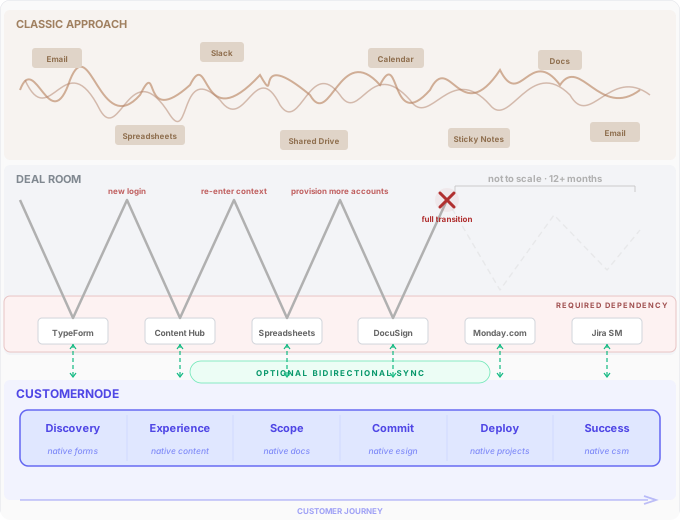
Discovery runs in TypeForm. Scope lives in a spreadsheet. Signature routes through DocuSign. Deployment tracking moves to Monday.com.
While the category advertises integrations as a core feature, in practice every step of the deal breaks into a different system, a different login, and a different source of truth, often stitched together by nothing more than a web link.
Then the deal closes.
CS gets a link to a workspace full of sales collateral. They schedule a transition call. Three months later, implementation stalls. CS asks questions that sales already answered in discovery. The buyer re-explains their constraints to someone who was not in the room. Everything that mattered stays behind in a workspace that was never designed to carry context forward.
The deal room is not the system itself. It is a presentation layer stretched across a fragmented stack, with half the logic living inside automations configured by an ops manager who left two years ago.
In CustomerNode, there is no transition call. The success team simply logs into a live engagement, the customer stays in the same place they’ve been and the journey continues.
Tactically Adopted, Not Mission Critical
Deal rooms solve enough friction to get adopted. Reps like them. Buyers often appreciate them. They make engagements feel cleaner and more organized.
But losing the deal room rarely prevents anyone from doing their job. That’s why the category never broke out.
Can AI Save the Day?
Probably not.
Most deal rooms now advertise AI features: coaching, scoring, summaries, MEDDICC grading. The question is not whether they have AI. It is whether the architecture produces the right data for AI to learn from.
A presentation layer generates shallow event data: who opened a file, who checked a box, how long they stayed on a page.
But the signals that actually matter usually live somewhere else.
Did the deployment succeed? Did the customer expand? Did the account stall three months later because a constraint uncovered in discovery was never addressed?
No system connects those outcomes back to the beginning of the process, because the beginning and the end usually live in different systems.
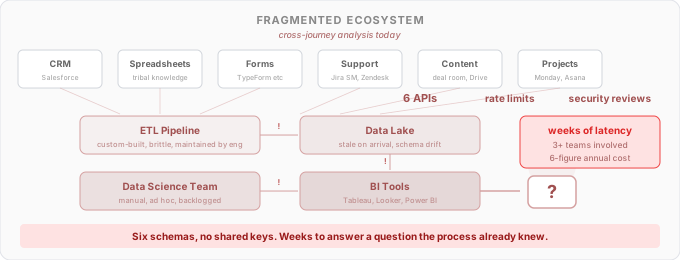
Connecting six systems through APIs into an ETL pipeline, dumping everything into a data lake, then hiring data engineers, data scientists, and BI teams to make sense of it all takes months and hundreds of thousands of dollars, if not more.
And even then, the output is usually partial, stale, and disconnected from the actual workflow where decisions get made.
No single system holds the full picture. No single system can reliably learn from it.
Even if AI could save the day… would it choose this architecture?
Or would it design a different one entirely?
The Missing Layer
In a previous article, we argued that B2B software is shifting from systems that record work to systems that run it. That shift is what categories like deal rooms have been circling around without fully reaching.
Three questions separate these categories: where does the system sit in the stack, how does it structure data, and what does it build over time?
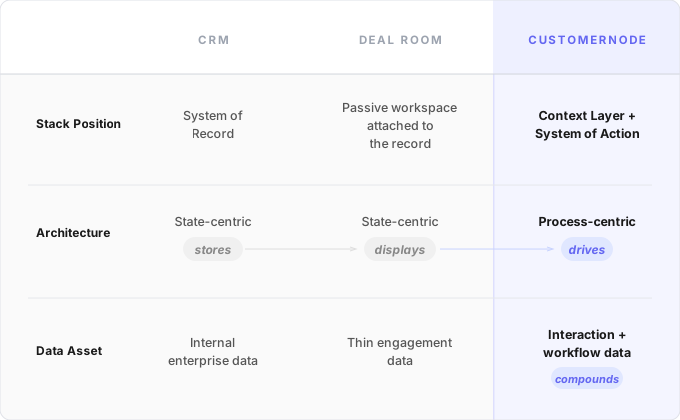
CRM occupies the first column. Deal rooms occupy the second.
CustomerNode is built around the third, new layer.
Revenue teams already know this layer needs to exist because most have already stitched together rough versions of it themselves: discovery in one system, implementation in another, customer communication spread across email, Slack, spreadsheets, and project boards nobody updates after week two.
So how would AI save the day?
It would collapse that fragmentation into a single operational system that carries context forward through the entire engagement.
Because before, it could tell you who opened a document.
Now, it can directly read and write the data it needs—through strict user-approved guardrails—to administer discovery, adapt scope around customer constraints, coordinate execution across teams, adjust timelines dynamically, and learn from the operational outcomes that follow.
That is not a feature difference. It is a category difference.
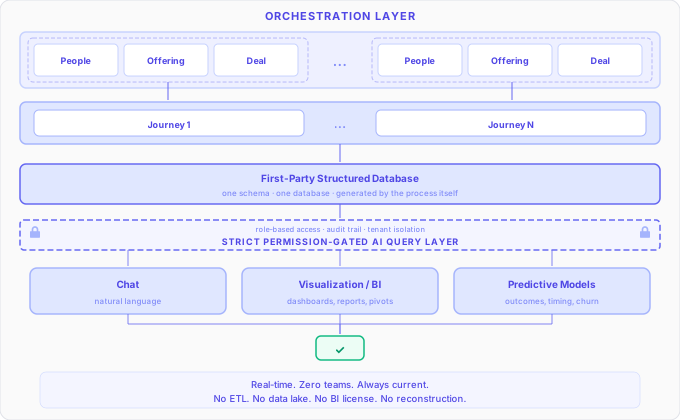
This is the closest thing that exists to replicating what a senior sales operator actually does.
The missing pieces are trust and human judgment, neither of which are likely to disappear anytime soon.
The result is a human-in-the-loop system that raises the operational level of the entire team: C players execute like B players, B players execute like A players, and A players finally operate at the scale their talent always deserved.
Deal Rooms Are a Feature. CustomerNode Is a System.
The deal room category did not fail because the founders were wrong. The problem was real. The execution was reasonable. The market validated it.
The category failed because it solved the visible pain and stopped there—and the visible pain was never expensive enough to justify the investment.
For most of the last decade, the alternative did not exist.
The technology required to operationalize expertise across an entire revenue organization simply was not ready yet.
That architecture now exists, and CustomerNode has filed a non-provisional patent on the underlying machine-implemented process.[8]
The category shift is not coming. It is already underway.
In a deal room, progress still depends mostly on the individual seller. Performance varies. Context resets. Operational knowledge leaves with the people who built it.
In CustomerNode, progress is driven by the system itself. And systems scale.
Sources
- GetAccept raised $20M Series B led by Bessemer (Dec 2020) — TechCrunch
- Accord raised $17M ($6M seed from Stripe, $10M Series A from Matrix Partners, Jan 2023) — TechCrunch
- Recapped raised $6M seed led by CRV (Jul 2021) — TechCrunch
- Journey.io acquired by XO Capital at ~$18K MRR (Nov 2023) — Andrew Pierno, XO Capital
- Salesforce acquired Quip for $750M (Aug 2016) — TechCrunch
- Category revenue estimate ~$25–30M; DealHub ~$62M (2024 estimates) — GetLatka, acquisition disclosures, and funding announcements
- 77% of B2B buyers described their last purchase as “very complex or difficult” — Gartner, “The New B2B Buying Journey” (2019)
- U.S. Patent Application No. 19/650,255 — “Agentic AI System for Dynamic Customer Journey Orchestration” — Utility nonprovisional, filed Apr. 16, 2026, USPTO
Deal rooms are a feature. CustomerNode is a system. The shift is from selling as an art to selling as an operational capability.