

Welcome to the Good Life
At 89, Willie Montag keeps a schedule most founders only daydream about. Mornings on the golf course. Afternoons at the gym, interrupted only long enough to keep an eye on one of his investment properties. Evenings at the dinner table with his loving wife, often joined by some of his four children and eleven grandchildren. And when the cards come out, a seat at the poker table.
Until the late 1970s he and his father ran a parts distribution business for Evinrude, the outboard motor maker. His company sat in the middle of a chain of businesses: the manufacturer upstream, the dealers downstream, and boat owners at the end of it waiting on a part before the season started.

Before the internet, a business like theirs ran on the telephone. Mornings started with a huge queue of callers: dealers chasing parts before the season, orders to confirm with Evinrude, shipments gone missing somewhere in between.
It was a young Willie who introduced computing into the business while most distributors their size kept inventory on paper cards and typed invoices in triplicate. Having run the business by hand and then on its first computers gave him an intimate familiarity with the physics of how buying, selling, and modern business really work.
When you get a text from a guy like that, who also happens to be your grandfather, you read it twice.
Sounds Like Your Competition
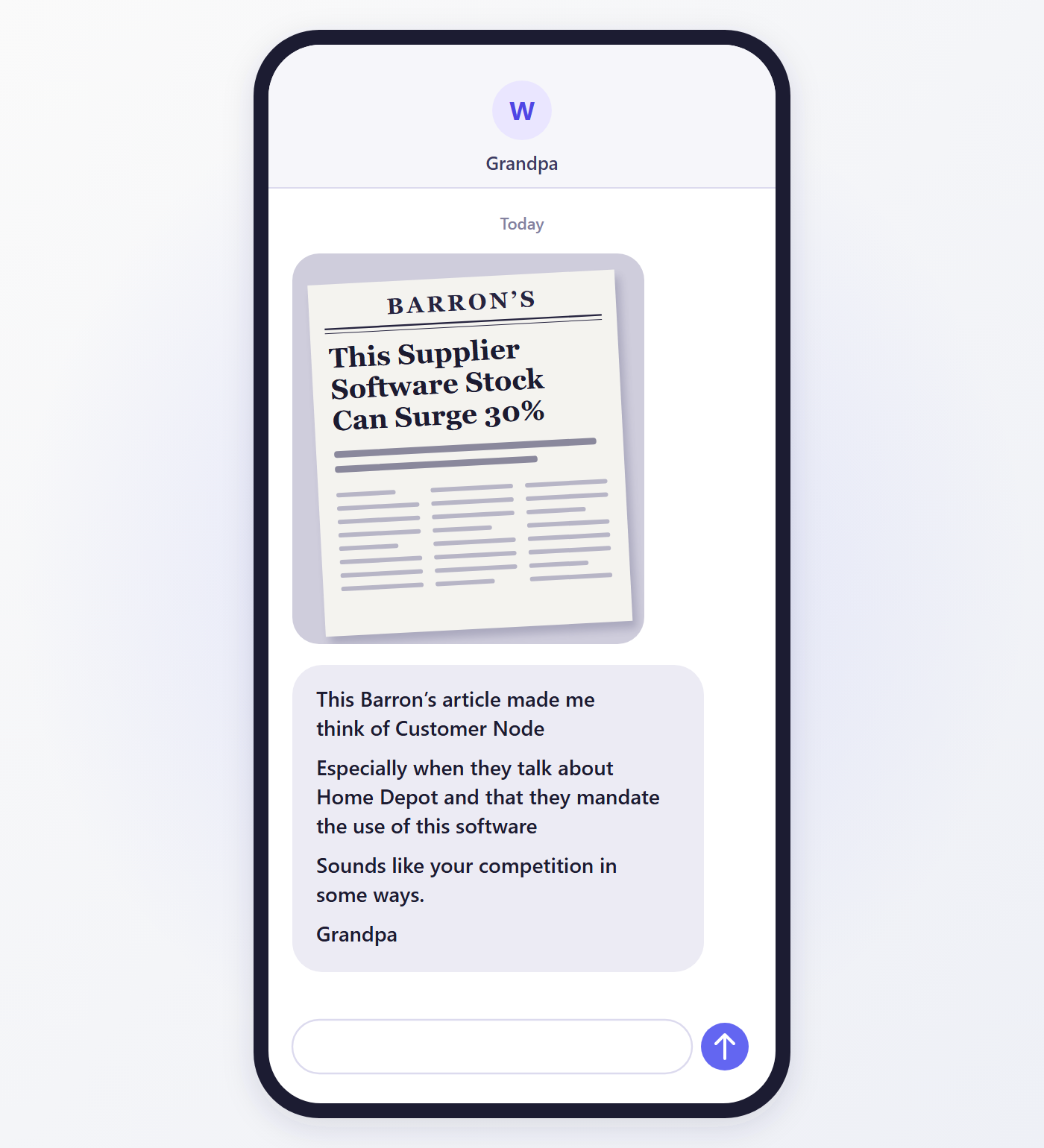
The article was a Barron’s stock pick on SPS Commerce, which runs a network retailers and suppliers use to exchange orders, invoices, and shipping notices. Barron’s argued the market had wrongly filed SPS with the software companies AI is supposed to replace. The case rested on the network itself and on years of data about how each retailer and supplier does business, the kind of data a newcomer’s AI could not match. It valued the stock about 30% above its price.1
While Willie was intrigued by the investment opportunity, he followed the logic one step further. If Home Depot can require suppliers to conform to its process, and SPS makes that possible at scale, what happens if high-consideration buyers eventually do the same?
If the buyer owns the process and makes sellers conform, there is nothing left for CustomerNode to orchestrate. The problem his grandson’s company is built to solve disappears.
Fair point, Grandpa.
Circuit Boards and Circuit Design
The answer starts with a distinction.
Imagine SpaceX making two purchases.
The first is a circuit board. The board itself may be extraordinarily sophisticated, but the purchase can be made legible before a supplier ever enters the picture. Engineering defines the requirements. Procurement can send those requirements to qualified suppliers, compare price and lead time, issue a purchase order, and inspect what arrives against a known spec. The buyer knows what has to happen, who has to do it, and what counts as done.
Now imagine SpaceX choosing the electronic design software its engineers will use to design those boards.
There is no equivalent spec to hand procurement. Engineers have to decide whether the software fits the way they work. Their managers have to understand what changing tools would disrupt. IT has to know how it fits the existing environment. Security has questions of its own. Legal, finance, and procurement enter for different reasons at different times. Some of the requirements only become clear once those people, who do not typically work directly with one another, start evaluating the product together.
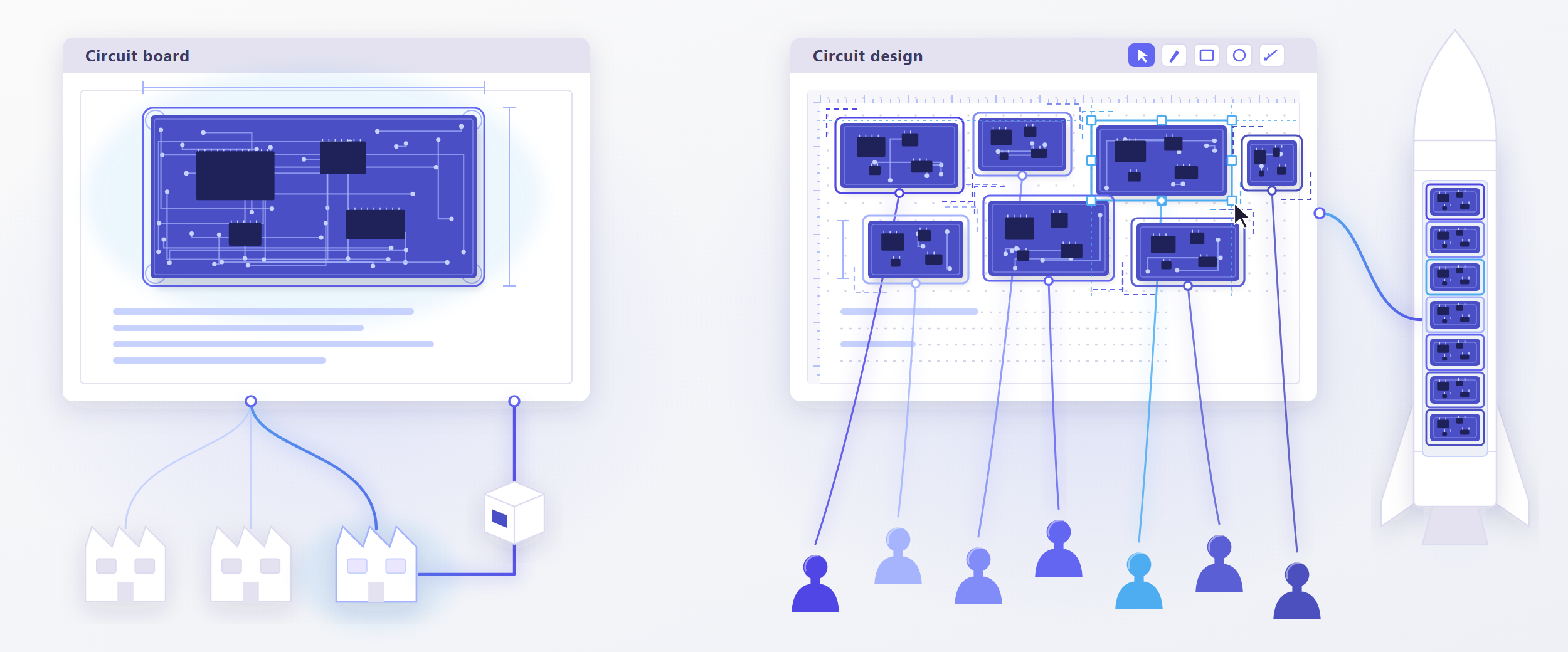
The buyer does own parts of this purchase. It controls the RFP, the security review, the contract, procurement, and onboarding. Those are real processes, but they are gates around the decision, not the process by which the decision gets made. In the middle, the customer still has to bring people together, surface requirements, resolve tradeoffs, and work out what it actually wants.
Same company. Two sophisticated products. Two completely different kinds of buying.
The Journey to SPS
Now take the circuit board purchase and repeat it thousands of times.
This is the daily reality for businesses like Home Depot, across thousands of products and thousands of stores. It is not practical to renegotiate how an order, shipment, or invoice should work every time the company buys from a supplier. So Home Depot defines the rules once. Suppliers receive purchase orders in its format, send shipping notices the way it expects, submit invoices on its terms, and absorb the cost when they get it wrong.
SPS carries those rules across a network of more than 120,000 trading partners.2 Instead of every retailer and supplier working out the same transactions from scratch, the network gives those transactions a system. For the companies on it, the morning queue of callers Willie once answered is gone.
But… someone has to buy SPS.
A supplier considering SPS has to bring together supply chain, IT, finance, security, legal, and procurement. Each function owns a piece of the evaluation, but nobody owns the decision as a whole. The company buying software designed to eliminate ad hoc coordination still coordinates the purchase through meetings, email, documents, follow-ups, and whoever remembers what was agreed.
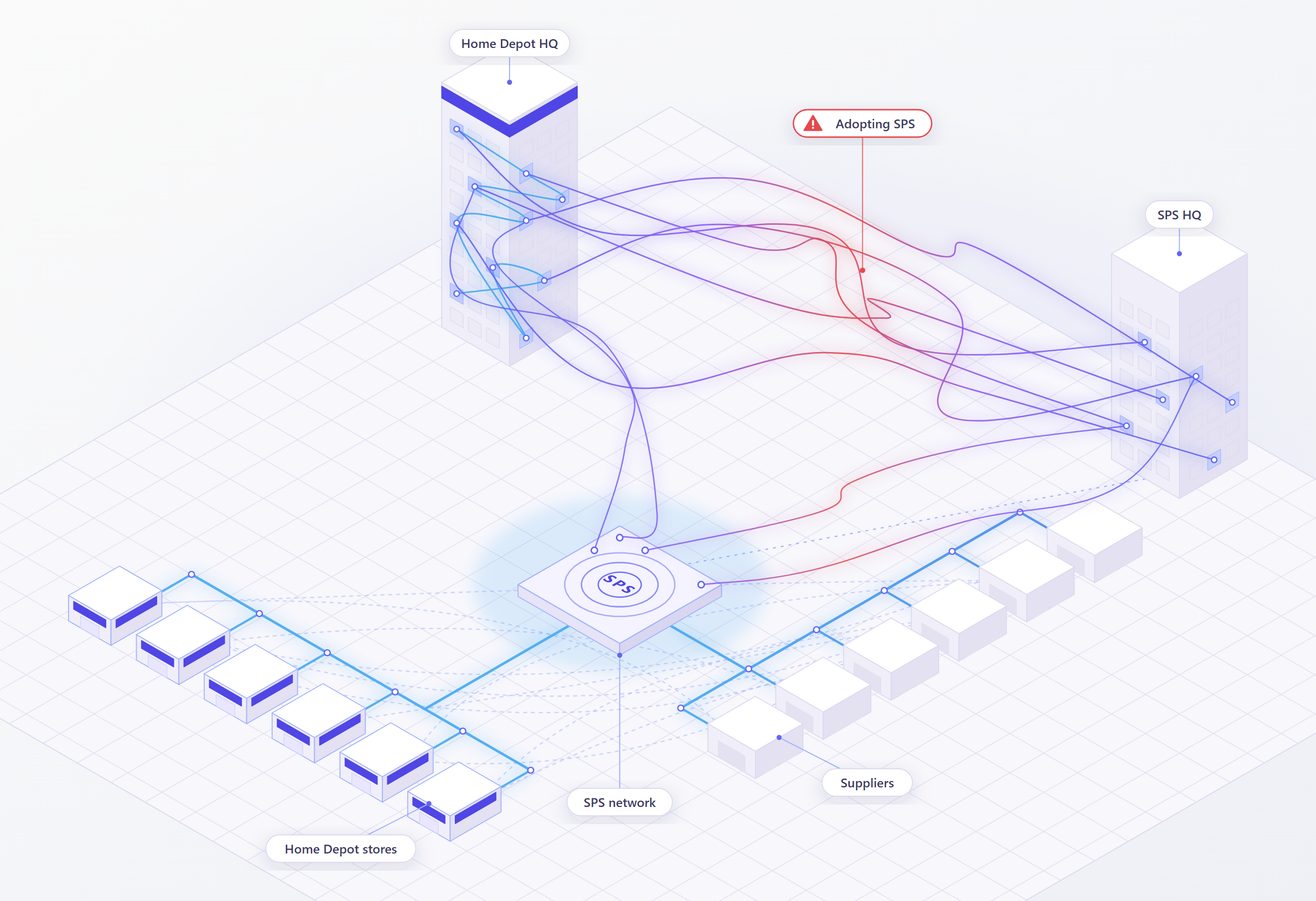
That is not a contradiction. It is the economics of process ownership.
Who Can Afford to Own the Process
A simple purchase can stay ad hoc because there is barely a process to systematize. A complicated purchase is different. Every requirement, stakeholder, tradeoff, and approval adds cost.
Whether that cost is worth systematizing depends on how often the problem comes back.
Home Depot deals with orders, shipments, and invoices every day across thousands of suppliers, so the cost of designing the process once can be spread across an enormous number of transactions. A company evaluating SPS may face an equally complicated decision, but it makes that purchase once and moves on. Building a system for it may cost more than simply getting through it.
The seller sees the opposite economics. What looks like a one-time decision to each customer is a repeating class of problem to the company selling to them.
That is where process ownership starts to flip: the customer experiences the instance; the seller experiences the pattern.

The Adaptive Standard
A vendor-owned process has an interesting catch. The seller runs the process, but the people inside it work for the customer.
Home Depot has both repetition and leverage. Suppliers who want access to its shelf space have little choice but to conform to its rules.
A complex B2B seller has repetition without that leverage. It cannot tell a customer which engineers should participate, what security will require, which executive needs to approve the deal, or what concerns will emerge halfway through the evaluation.
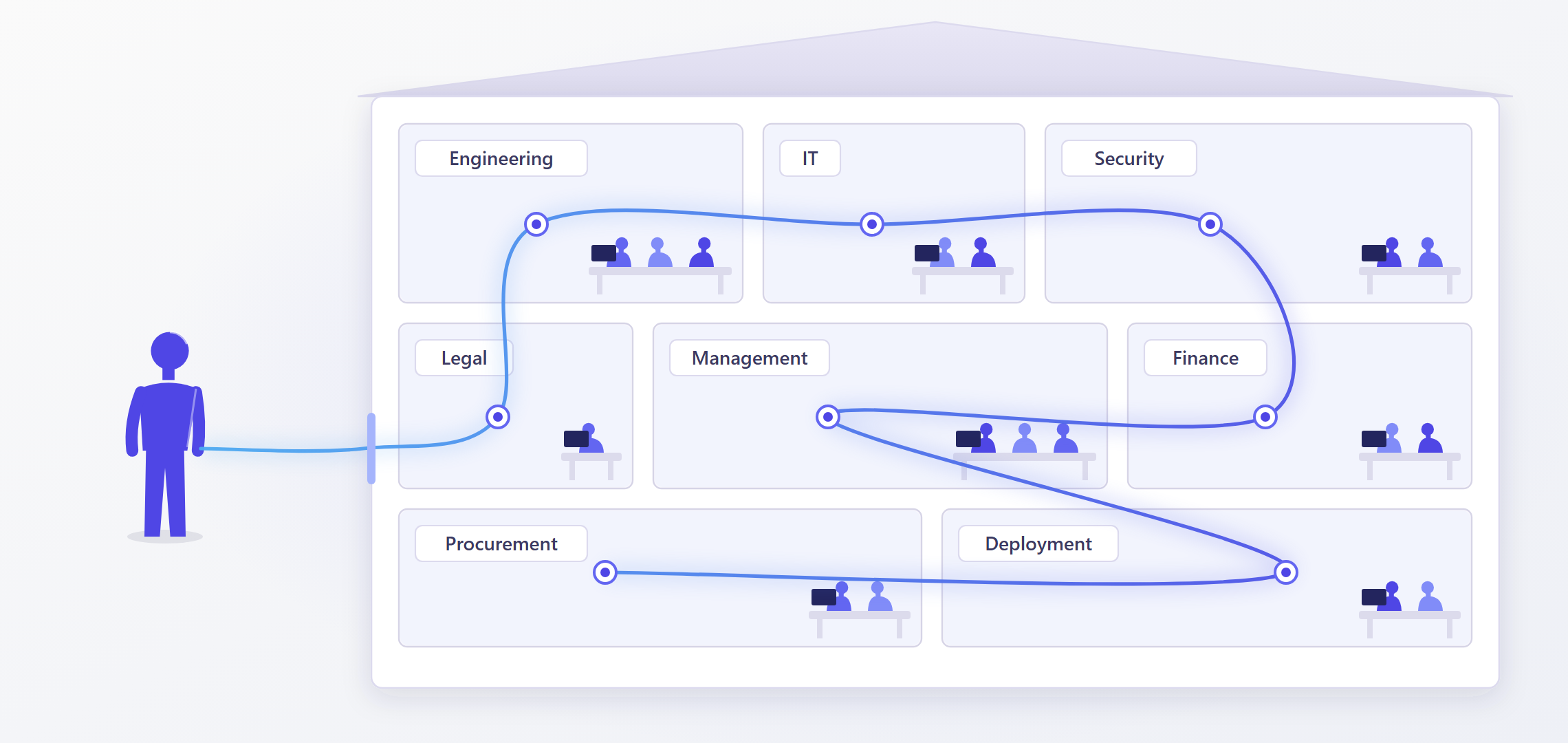
In a complex purchase, the seller is responsible for the process
and has no authority over the people in it.
For decades, good salespeople, solution engineers, consultants, and executives have handled that tension manually: bring a proven way of working, then reshape it around each customer as the deal unfolds.
CustomerNode is built for exactly that. The common shape is defined once: the stages, work, information, and dependencies that tend to recur. Each account then takes its own path through it, shaped by the people involved and what emerges along the way.
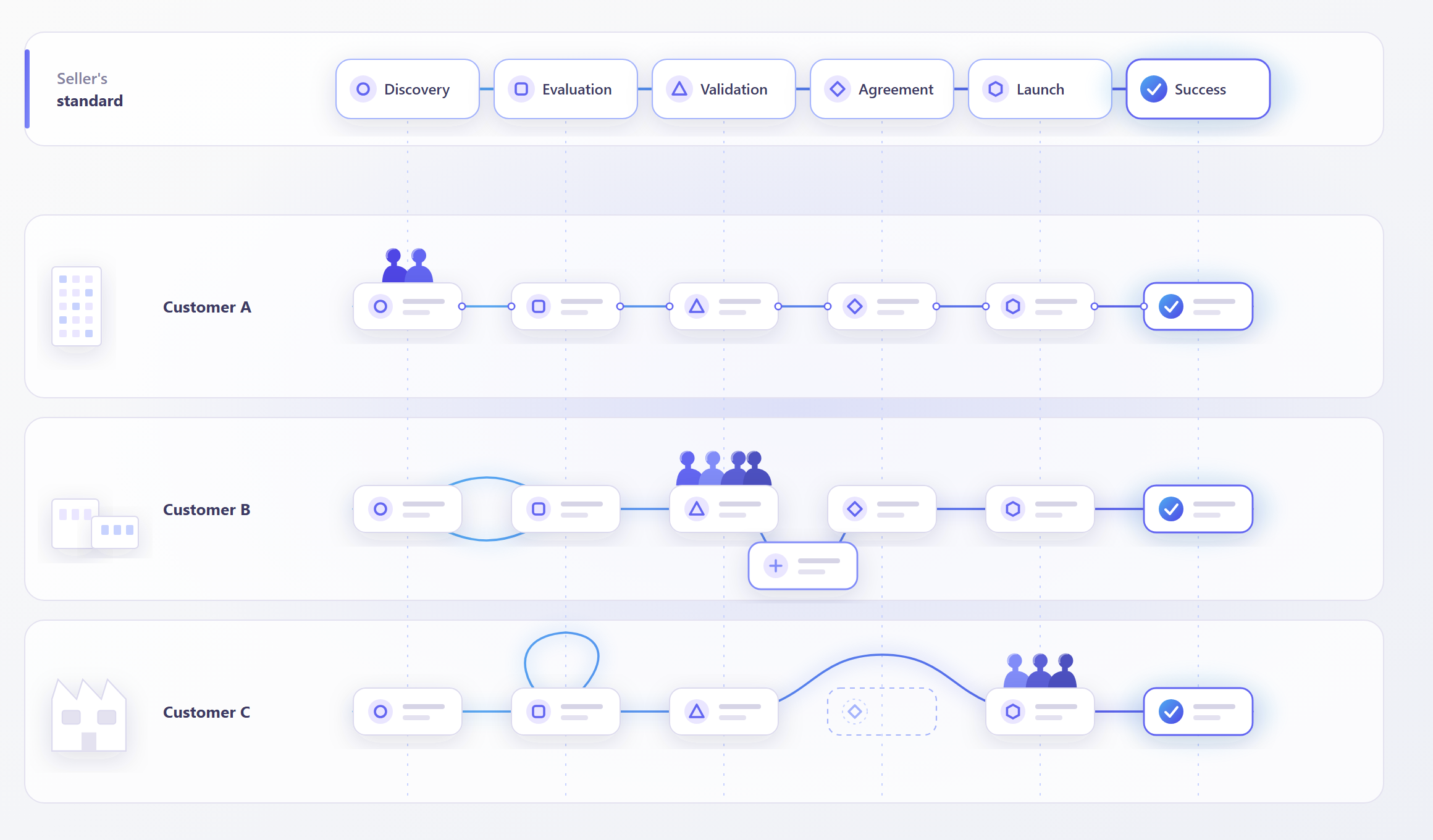
First-Party AI™ makes that variation systematic. It uses the seller’s process and the first-party context accumulating around each customer to adapt the journey without losing the structure underneath.
The economics require a standard. The customer makes every instance different.
That is the adaptive standard.
Willie’s Wisdom
Which brings us back to Willie.
His business spent decades moving parts through a chain of manufacturers, distributors, dealers, and customers. SPS does something similar with transactions. CustomerNode does it with decisions.
The thing moving through the system has changed. The economics behind it have not.
Nearly 50 years after selling his company, Willie recognized that pattern in a Barron’s stock tip.
Turns out, the discomfort behind “sounds like your competition” is the wisdom worth unpacking.
Sources
- Barron’s, “This Supplier Software Stock Can Surge 30%.” Barron’s
- SPS Commerce describes its retail network as connecting more than 120,000 trading partners, with over 50,000 recurring revenue customers. SPS Commerce. Home Depot requires suppliers to exchange purchase orders, advance ship notices, and invoices electronically to its standards; suppliers commonly meet those requirements through networks such as SPS. SPS Commerce, Home Depot
When you get a “sounds like your competition” text from an 89-year-old founder whose exit funded five decades of retirement, you read it twice.