

Beam Us Down, Scotty
Three and a half billion years ago, an ancient river cut through the wall of Jezero Crater near the equator of Mars and emptied into a shallow lake.
On Earth, rivers collect traces of life across entire landscapes and deposit them where water pools. When rivers like Jezero's dry up, the delta hardens into stone. If life ever existed on Mars, its traces would likely be preserved there.
NASA sent Perseverance, a Mars rover, to search for those traces.
The difficult part was getting there.
Jezero is ringed by cliffs, dunes, and boulder fields. The walls made landing inside it the only way in. A few feet off on approach could overturn a rover the size of a car, with no one on the planet to flip it back. And Mars had a brutal track record: only four in ten missions sent there had ever succeeded.[1]
On February 18, 2021, NASA sent the $2.7 billion mission straight at it anyway.
Perseverance hit the Martian atmosphere at 12,500 miles an hour. Plasma wrapped around the heat shield. Earth was eleven minutes away by radio, which meant mission control could only watch a record of what had already happened. By the time anyone there saw a problem, the rover would already be wreckage.
The computers onboard had seconds to work out where they were, compare the ground below against known hazards, and decide where the rover should land.[2][3]
Mission control waited.
“Touchdown confirmed.”
The computer that guided the landing ran on a chip designed in 1997.
NASA had left the frontier on Earth and sent the architecture it knew. The choice traded novelty for a system whose limits were already understood. On Mars, that difference can decide whether a mission starts or ends on impact.
What Maturity Knows
NASA had already learned what happens when known limits are ignored.
On January 28, 1986, the temperature at Kennedy Space Center's Pad 39B was 36°F, fifteen degrees colder than any Shuttle launch before it. The joint on the right-side solid rocket booster was even colder, sitting close to freezing.[4]
The night before, fifteen engineers at Morton Thiokol had recommended against launch.
They had the flight history in front of them. The O-rings sealing the booster joints stiffened in the cold, and the coldest Shuttle launch to date had been 53°F. Their written position was simple: do not fly below it.
Under pressure from NASA, Thiokol management reversed the recommendation. The written engineering position never reached the people making the final call.[5]
Seventy-three seconds after ignition, the right-side booster's aft field joint burned through.
Challenger broke apart at 48,000 feet.
Nothing about the failure was new. A year earlier, Discovery had returned from a cold launch with the most severe O-ring damage the program had ever recorded. The warning was already in the flight logs.[6]
The catastrophe did not come from unknown physics. It came from ignoring what experience had already made visible.
That is what maturity carries: a history of failure. The edges have been found. Strange behavior has happened often enough to become recognizable. Failure modes acquire names, precedents, and workarounds.
A mature system carries scar tissue, and scar tissue can be designed around. A new system has less of it because its own operating history has barely begun.
Where the Frontier Belongs
The lesson is not to avoid the frontier. Sometimes the frontier is the entire point.
Twenty-nine years after Challenger, on December 21, 2015, a Falcon 9 booster returned from space and landed upright on a concrete pad at Cape Canaveral.
No orbital-class booster had ever returned from space and landed upright under its own power.[7]
The landing looked like science fiction. Much of the machinery underneath it came from ideas aerospace had understood for decades.
Falcon 9's Merlin engine ran a gas-generator cycle, the same fundamental cycle that powered the F-1 engines beneath Saturn V, the rocket that carried astronauts to the moon. Its injector lineage reached back to the Apollo Lunar Module descent engine. It burned kerosene, a propellant engineers had spent generations learning how to manufacture, handle, ignite, and control.[8]
The engine cycle was known. The injector architecture was known. The propellant was known.
The new thing was getting the booster back.
That was where novelty changed the economics of the mission. A reusable first stage could alter the cost structure of spaceflight in a way another exotic engine cycle could not. So SpaceX concentrated frontier risk there and built the rest from technology with deep operating history.
Eventually, even the frontier part became routine.
By 2024, more than 95 percent of Falcon 9 launches flew on a first stage that had already flown before.[9]
The frontier belongs where it changes the mission.
The Life of a Node
The architecture that landed Perseverance in Jezero Crater on Mars had once been new.
In 1997, the PowerPC 750, the commercial processor family from which Perseverance's RAD750 flight computer descended, sat near the edge of commercial computing.
Apple put it inside its new G3 machines that year, and the following year wrapped it in translucent blue plastic and shipped the iMac, a computer designed to look as though the future had reached the desk.[10]
Faster, cleaner, unmistakably new.
Then the future moved.
Smaller transistors and faster processors took the glamour with them. The translucent blue iMacs were left to yellow in school computer labs and spare bedrooms while the industry chased the next frontier.
Yet descendants of the chip kept rolling off production lines for decades.[11]
By then, the expensive part had already happened. The factories had learned the process. The equipment had been paid down. Defects had appeared often enough to be understood. Years of production turned uncertainty into routine, and routine into lower prices.
That is how a node matures.
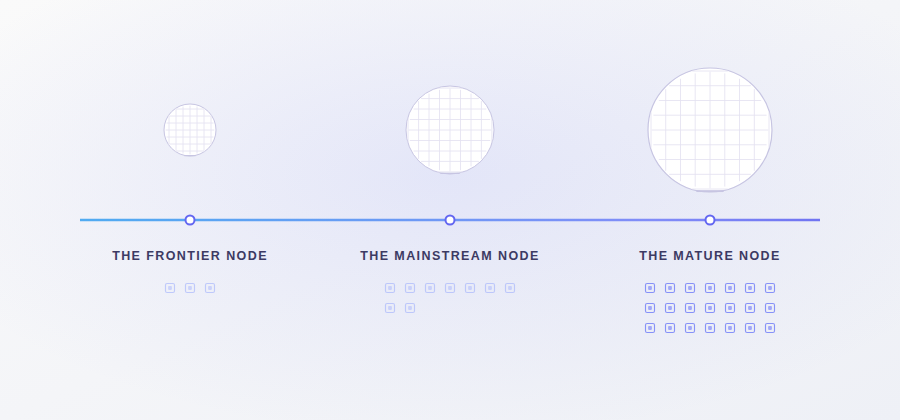
At the frontier, a semiconductor process is expensive because it is doing something the industry could not do before. The fabs are new. Wafer yields are still being learned. Every working chip expands the edge of what is possible.
Then the process settles.
Engineers understand it better. More wafers survive the line. Tooling improves. Capacity grows. The price begins to fall.
Eventually the node becomes ordinary enough to disappear into the world around us. It runs cars, factories, appliances, servers, industrial controls, medical equipment, and thousands of products whose buyers will never know what process made the chips inside them.
Roughly 70 percent of global foundry capacity now sits on mature nodes.[12]
The frontier invents the capability. The mainstream makes it practical. The mature node gives it to the world.
From Wafers to Weights
AI is moving through the same economic curve, only much faster.
A semiconductor begins as material and ends as logic etched into a wafer. A model begins as data and ends as intelligence encoded into weights. Physically, they share almost nothing. Economically, both begin at an expensive frontier and become more useful to the rest of the world as yesterday's capability gets cheaper.
A semiconductor node may take a decade to make that journey. A model can cover comparable economic ground in a year.
Training frontier models has grown more than twice as expensive each year since 2016. GPT-4 crossed $100 million, and billion-dollar training runs are entering the pipeline.[13] Meanwhile, the cost of yesterday's capability is collapsing: in March 2023, a million tokens at roughly GPT-4-level performance cost about $36, and comparable capability can now cost pennies.[14]
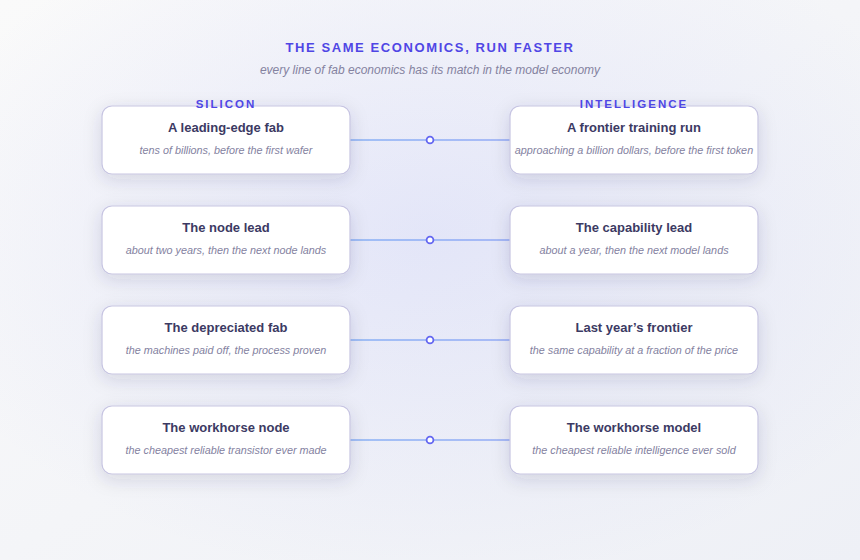
Enterprise AI does not buy training runs. It buys calls.
The labs pay to move the frontier. Everyone else rents the result as it becomes cheaper, better understood, and easier to build around.
The newest model may score highest, but it arrives with the least operating history. An older model has spent far more time in real use. Its failures have names, examples, and workarounds.
A customer-facing agent does not fail on a benchmark. It fails when unexpected behavior reaches a human in a situation no benchmark happened to represent and no safety review anticipated. The evidence that matters lives in the flight log of the model that has already flown.
The Opportunity of the Mature Node
Push the frontier where the work demands it. Build mature everywhere else.
Most enterprise workflows do not turn on whatever model leads the benchmark table this quarter. Their value comes from solving a specific commercial problem reliably, repeatedly, and cheaply enough to become part of ordinary work.
Choose a model whose edges are understood. Fence the failures you have seen. Give it the context it needs, constrain what it can do, and place it inside a system built to run the work, not one designed to record it.
That system cannot depend on the model for its identity. If most of the product's value lives in access to a model, the model provider can eventually absorb it. Durable value has to accumulate elsewhere: in the workflow, the context, the judgment encoded around it, and the customer relationships the model alone does not own. The model should be replaceable. The system around it should become harder to replace with every customer, every decision, and every cycle of use.
Once intelligence is cheap, design for abundance. Then exercise restraint, because the user's attention is what you are now spending.
The frontier is a race. The mature node is a schedule. You can build a company on a schedule.
Postscript: maturenode.com
The layer carrying most of the semiconductor industry's capacity barely has a public identity outside the industry itself.
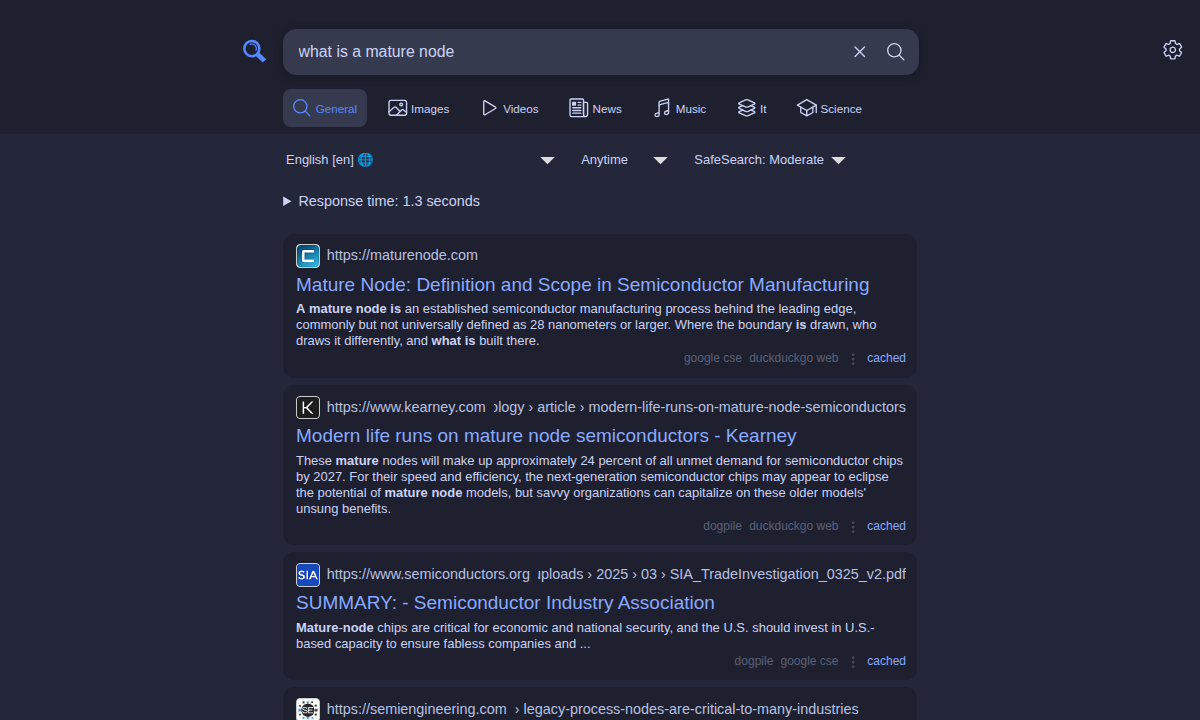
We bought maturenode.com for ten dollars. An industry willing to spend $20 billion on a single leading-edge fab had never claimed the obvious name for the technology carrying most of its volume.
A week later, the page ranked above fab operators, trade publications, and companies that had spent decades building the technology.
That blind spot belonged to silicon. The next one is intelligence.
Sources
- Historical Mars mission success rate: across every era of the Space Age, roughly 40 percent of missions sent to Mars have succeeded (Astronomy.com, “Mars Madness: How Perseverance will stick the landing during its 7 minutes of terror,” 2021). Jezero Crater’s cliffs, boulder fields, and dunes had ruled it out as a landing site until the development of Terrain Relative Navigation made it reachable (NASA/JPL, “Terrain Relative Navigation: Landing Between the Hazards,” Mars 2020 mission materials).
- Perseverance’s landing, February 18, 2021: entry into the Martian atmosphere at roughly 12,500 mph; Mars approximately 126 million miles from Earth that day, a one-way radio delay of about 11 minutes; the entry-descent-landing sequence lasting about seven minutes, nicknamed “seven minutes of terror” by JPL engineers; total mission cost approximately $2.7 billion (NASA/JPL Mars 2020 mission materials, 2021; The Planetary Society, “The Cost of Perseverance,” 2021). Swati Mohan, the mission’s guidance and controls operations lead, narrated the descent live from JPL mission control and announced “Touchdown confirmed” (NASA/JPL landing broadcast; CNN, “The face of the Perseverance landing was an Indian American woman,” February 19, 2021).
- The parachute: a 70.5-foot-diameter supersonic parachute, packed into an 18-by-26-inch cylinder compressed to the density of wood, mortar-fired and fully inflated in about 0.6 seconds at a Mach number of 1.82 (NASA/JPL, “Testing Proves Its Worth With Successful Mars Parachute Deployment,” 2021; Journal of Spacecraft and Rockets, “Reconstructed Performance of the Mars 2020 Parachute Decelerator System”). The heat shield separated roughly 20 seconds later, activating Terrain Relative Navigation, the first autonomous, camera-based hazard-avoidance system used in a Mars landing (NASA/JPL, “Terrain Relative Navigation: Landing Between the Hazards”).
- Challenger, January 28, 1986: ambient temperature at Pad 39B at the 11:38 EST launch was approximately 36°F, fifteen degrees colder than any prior Shuttle launch; the right-side SRB aft field joint itself was estimated closer to freezing (Report of the Presidential Commission on the Space Shuttle Challenger Accident [the Rogers Commission], Volume 1, Chapter 3, 1986).
- The night before launch, engineers at Morton Thiokol unanimously recommended against flying below 53°F (the coldest prior Shuttle launch); Thiokol management reversed the engineering recommendation under pressure from NASA, and the written engineering position did not reach NASA’s Level I launch decision-makers (Rogers Commission Report, Volume 1; Online Ethics Center, “A Management Decision Overrides an Engineering Recommendation Not to Launch”; testimony of Roger Boisjoly, senior engineer on the Morton Thiokol seals task force).
- Prior cold-weather O-ring damage: STS-51-C (Discovery, January 24, 1985) launched after overnight temperatures in the teens and returned with the most severe O-ring erosion and blow-by the program had recorded to date, including unprecedented primary O-ring penetration at a right-SRB field joint (Rogers Commission Report, Volume 1; NASA, “40 Years Ago: STS-51C, The First Dedicated Department of Defense Shuttle Mission”). Challenger broke apart at T+73 seconds at approximately 48,000 feet (Rogers Commission Report, Volume 2, Appendix E).
- First propulsive landing of an orbital-class booster: SpaceX Falcon 9 flight 20, booster B1019, Landing Zone 1, Cape Canaveral, December 21, 2015 (local Florida; 22 December 01:29 UTC).
- The Merlin engine uses a kerosene/liquid-oxygen gas-generator cycle, the same fundamental cycle as the F-1 engines that flew Saturn V in the 1960s; its pintle injector architecture traces to the TRW Apollo Lunar Module descent engine, work led by Tom Mueller before he co-founded SpaceX.
- In 2024, more than 95 percent of Falcon 9 and Falcon Heavy launches flew on a previously-flown first-stage booster (SpaceX launch statistics, 2024).
- The RAD750: a radiation-hardened derivative of the PowerPC 750 (the processor family that shipped in the 1998 iMac G3), clocked at approximately 200 MHz, rated to withstand roughly 1,000,000 rads and temperatures from -55°C to 125°C, fabricated at a 250nm/150nm process node (BAE Systems product literature; Big Think, “NASA’s Perseverance rover has a 1997 computer chip brain. Here’s why,” 2021).
- Prior flight heritage of the RAD750/RAD6000 lineage: Curiosity’s 2012 Mars landing used twin RAD750 processors; the lineage also flew on the Mars Reconnaissance Orbiter and Kepler (NASA/JPL mission documentation).
- Mature-node capacity: TrendForce projects the global ratio of mature (28nm and older) to advanced foundry capacity to hold near 70:30 through 2027.
- Frontier training costs: Epoch AI, “The Rising Costs of Training Frontier AI Models” (2024): 2.4x annual growth since 2016, with billion-dollar runs projected; Sam Altman on GPT-4 exceeding $100 million (Wired, 2023); Dario Amodei on billion-dollar-scale runs already training (2024). Hyperscaler capex: roughly $410 billion in 2025, guided to $600–725 billion for 2026, with the majority earmarked for AI infrastructure (company guidance and analyst aggregates, 2026).
- Inference price at fixed capability: Epoch AI, “LLM Inference Price Trends” (2025): a median decline near 50x per year across benchmarks, about 40x per year at GPT-4-level performance; a16z, “Welcome to LLMflation” (2024): roughly 10x per year at constant MMLU. Price points: GPT-4 at $30/$60 per million tokens at launch (March 2023, about $36 blended); GPT-4-class capability now $0.10–$0.28 per million input tokens.
NASA reached Mars on yesterday's technology. Why is enterprise AI gambling on tomorrow's?