
The Red Queen's Race
Every field that has watched rivals chase the same edge has a name for it.
Biologists call it the Red Queen, after the Lewis Carroll character who runs as fast as she can just to stay in place. In nature it is an arms race: predator and prey grow faster and deadlier across millions of years, and the only prize for all that speed is the right to keep pace.
Investors call it alpha decay. A strategy beats the market until enough desks discover it; then the crowd arrives, the spread closes, and the advantage decays into the average.
Strategists call it commoditization. Last year's must-have feature is standard in every competitor's demo this year, and what once commanded a premium slides to the price of entry, then to an expectation, then to a line nobody bothers to mention.
The names differ. The rule does not. An advantage everyone can buy is no advantage at all, only the new floor, and that floor is rising faster than it ever has.
This is the race most AI sales platforms are now running. The same capabilities, promised by every vendor, sold to everyone you compete with. Even when they work exactly as promised, they only raise the floor everyone stands on.
That floor is worth standing on. It's a big part of what we offer at CustomerNode. But it's not what sets us apart, and it's not what sets your company apart either.
A Double-Edged Sword
The Red Queen's race has a victim. It's not you, nor is it your competitors.
It is your customer.
You have felt this yourself, the last time six friends tried to pick a restaurant: everyone wants to go, the menus and times and locations pile up, and the group gets no closer to a decision.[1]
A complex deal is that same gridlock with the stakes turned up. The hard part was never reaching one person.[2] It is getting a group to converge: the champion and the skeptic, the budget holder, the person who will live with the choice, each with a goal of their own and a risk they alone will answer for. Every additional option, every additional proof point, every additional vendor with a credible story is one more thing the group has to reconcile.[3] More information does not loosen the knot. It pulls it tighter.
So the deal dies, but not to a competitor. It dies to no one at all. Forty to sixty percent simply end in no decision.[4]
In a market drowning in ways to sell, the scarce thing is a way to help a group decide together. That is where enduring value now lives.
People, Tools, and Time
None of this is unsolved. The people who are good at this do it on instinct, quarter after quarter, and make the hardest deals look easy.
They are rarely the best at pitching. They are the ones who have sat in the room before. They know which stakeholder holds the real veto, and which objection is the one no one has said out loud. They know how to take the risk off the table before it hardens into a no, and how to give a stalled group a recommendation it can defend and a path it can follow. This is not secret knowledge. It has been studied, named, and written into the best sales books of the last decade.
But the work still rests on those few people, propped up by a pile of tools that never quite connect: the CRM, the deck, the email thread, the spreadsheet no one updates past week two. Each tool made a piece of the job faster. None of them changed what the job is, which is still one rare person carrying a deal in their head, across weeks and quarters and a dozen disconnected systems. Efficiency went up. Capability never took a step.
A Mad Tea Party
Then AI arrives, and for the first time the step change looks possible. In most industries, the question is whether it replaces the people. Here, the premise barely holds. Replace whom, exactly... your customer? The sales rep the customer asks for by name? A deal is inherently a human process of people deciding together, and no model is going to sit in their chairs. Take the people out, and there is nothing left to run.
So the people stay. The process stays. And AI lands on top of both, a third force in a room that was already crowded.
What was a missing capability is now a mad tea party. People, process, and AI crowded around the same deal, all talking, no one keeping time. More power at the table than ever, and less of it pulling the same way.
Seven Barriers to Harmonization
The way out of the mad tea party is to make the forces work as one: your people, your process, and AI in sync instead of fighting for the same table. How those three come together is a fingerprint, unique to your company and impossible to copy, and it sharpens the more it runs: every opportunity, every journey, every customer you carry through.
It is the one advantage the rising floor cannot commoditize. Everyone can buy the same AI. No one can buy the way it works with your people and your process. Sustained, differentiated, yours alone.
That is what CustomerNode is built to do.
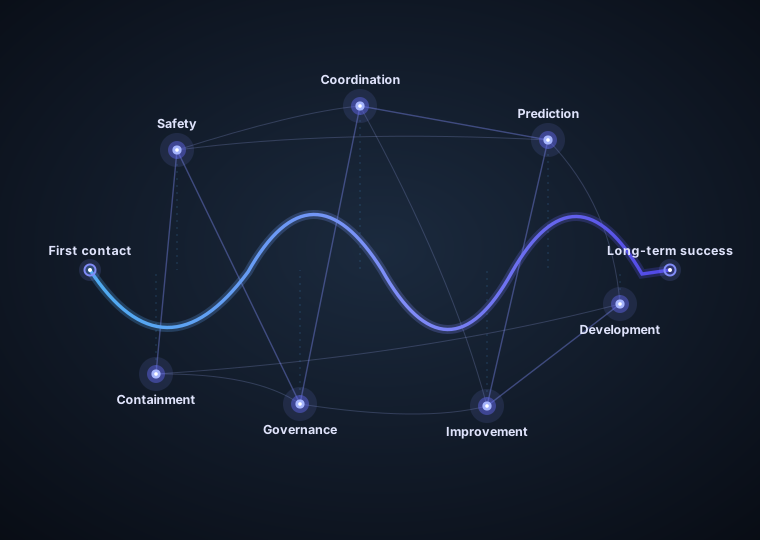
Getting the three to act as one is an unsolved technical problem. We have identified seven barriers in the way, each its own field of active research, studied in isolation, with its own papers and startups. But the pieces have never added up to a whole. Holding all seven at once, inside the particulars of how a single company's customers buy, took invention.
- Safety. Turning a model's suggestion into a real, versioned change to a live deal, without a human signing off on every step.
- Coordination. Running many autonomous agents inside the same journey without them colliding on the same work.
- Governance. Deciding what an agent is allowed to do before it ever touches the data, not catching it afterward.
- Prediction. Reading where a deal is headed from how people actually behave, not from who they are.
- Improvement. Closing the loop so the process sharpens from its own results, instead of a person editing it by hand forever.
- Development. Generating a multi-year journey and keeping it current, without authoring every step by hand.
- Containment. Holding each customer's process and data inside a boundary the architecture enforces, not the policy page.
A New Kind of Asset: Your Defensible Journey
This is the part no one can take from you. It stands on two things: the infrastructure beneath it, and a loop of data only your own journeys can fill.
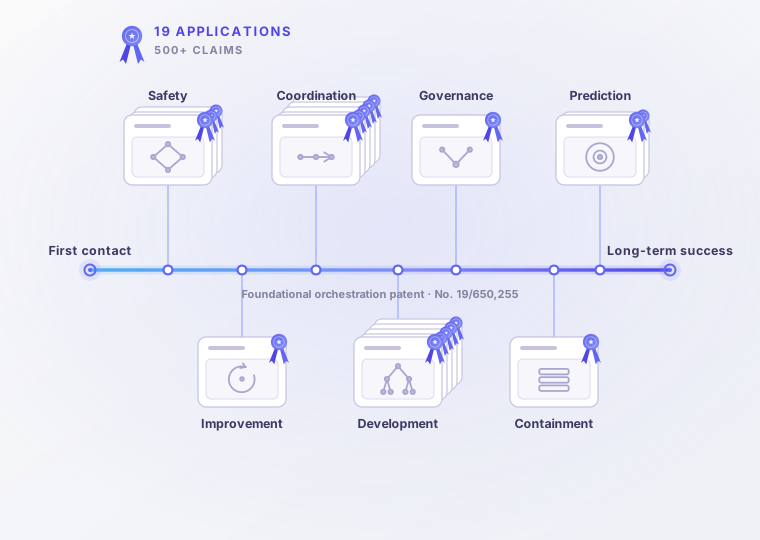
The infrastructure is those seven barriers solved: nineteen filings, every one patent pending, around a foundational patent for the orchestration that runs the journey. It sits above your system of record and runs the process the record could only store.
Then the loop runs on top. Truth keeps one canonical record of every state, action, and outcome, so every question the system asks is answered from the same source. Every journey adds to it, and the machine learns: which question surfaced the real budget, which stakeholder went quiet the week before a yes, which objection was never about the price. It sharpens with every journey, because the prior runs are still themselves. A year in, it knows what no one ever wrote down.
A competitor can copy your journey and buy the same tools. They cannot copy what it has learned from years of running yours, sealed inside a machine that shares with no one. They start at zero. The years do not transfer.
A human experience is not defensible.
The machine that produces it is.
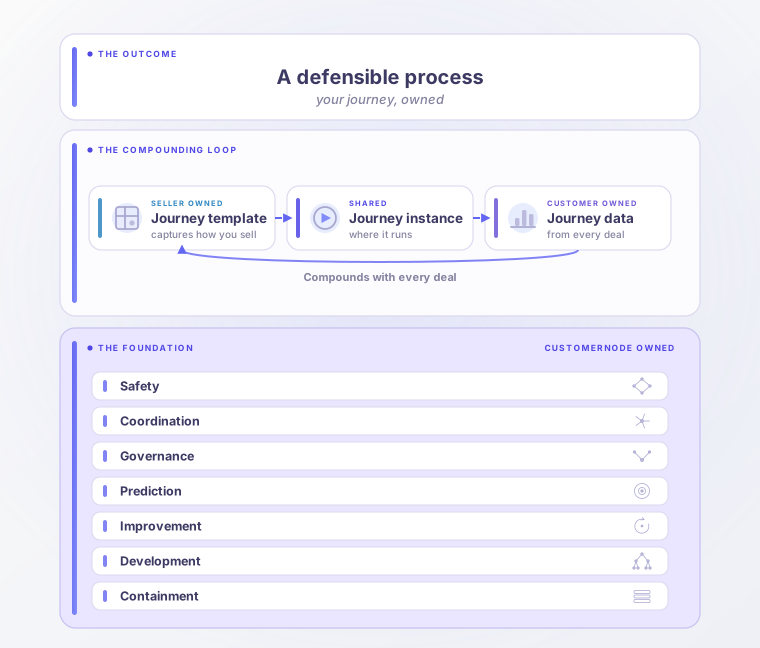
That is the asset. Not the tools, which anyone can buy, and not the motion, which anyone can generate. It is the journey itself, the way your company carries a fractured group all the way to a decision. It used to live in a handful of people, capped at the journeys they could personally run. Now it runs as a machine, behind every journey, sharper every quarter. The most valuable thing your company has was the one thing it could never protect. Now it is.
Beyond Sales
Everything here has been framed around buying and selling, but the problem underneath reaches much further. A patient through a course of treatment. A candidate through hiring. A borrower through underwriting. A company through fundraising. Strip the labels and the shape is the same: people, a process, and AI, three forces waiting to move as one.
We are focused on how companies buy and sell, the decisions too big and too crowded to reduce to a checkout. That is our market, not the edge of our invention. As the filings become public, beginning this fall, the exciting conversations will be with people taking it where customernode.com doesn't go.
Sources
- CustomerNode, The Deal Room Paradox: the group-decision problem behind stalled B2B deals — LinkedIn
- Matthew Dixon and Brent Adamson, The Challenger Sale (Portfolio, 2011): relationship-selling breaks down on complex, multi-stakeholder B2B deals — Penguin Random House
- Brent Adamson, “Sensemaking for Sales,” Harvard Business Review (Jan–Feb 2022): the overwhelming volume of information facing B2B buyers drives indecision and sharply reduces the likelihood of a purchase — HBR
- Matthew Dixon and Ted McKenna, The JOLT Effect (Portfolio, 2022): of the 40–60% of B2B deals that end in “no decision,” most go to customer indecision rather than the status quo, from an analysis of 2.5 million recorded sales calls — Amazon
Patent Applications
The foundational application (No. 19/650,255) was filed in April 2026, carrying priority from an earlier provisional, and eighteen more (Nos. 19/714,560 through 19/714,633) followed in June. The foundational is expected to publish around October 2026; the rest on the standard eighteen-month timeline, in late 2027. A handful, under Coordination and Development, cover the multi-agent system we use to build CustomerNode rather than the customer journey itself; the underlying architecture is the same. Grouped by layer:
Foundational
- Agentic AI System for Dynamic Customer Journey Orchestration (No. 19/650,255)
Safety
- Asynchronous Deferred Execution from Validated AI Outputs via Persistent Queue and DAG Scheduling (No. 19/714,607)
- Unified Real-Time Command Orchestration with Atomic State Consistency (No. 19/714,583)
- Indirect Execution of Deterministic Operations Derived from Probabilistic Generative Model Output Through a Schema-Validated Intermediate Structured Representation (No. 19/714,576)
Coordination
- Multi-Party Shared Execution State with Bilateral Engagement Intelligence for AI-Orchestrated Journeys (No. 19/714,586)
- Cross-Session Awareness with File-Overlap Conflict Avoidance for Parallel Autonomous Coding Agents (No. 19/714,610)
- Filesystem-First Agent Auto-Discovery with Signature-Pattern Inference for Context-Bounded Instantiation (No. 19/714,631)
- Out-of-Band Session State Inference from Append-Only Agent Transcripts for Coordinating Parallel Autonomous Coding Agents Without Runtime Integration (No. 19/714,560)
- Hierarchical and Cross-Operator Session Synchronization for Parallel Autonomous Coding Agents (No. 19/714,633)
Governance
- Policy-Governed Agentic Action Control for AI Systems of Action (No. 19/714,578)
Prediction
- Dual-Path Calibration with Deterministic Prediction from Structured Execution Data (No. 19/714,604)
- Behavioral Outcome Prediction for Multi-Party Structured Shared Workspaces Through a Three-Channel Information Taxonomy with Architectural Exclusion of Demographic and Firmographic Data (No. 19/714,565)
Improvement
- Closed-Loop Iterative Prompt Improvement of Generative AI with Two-Class Agent Separation (No. 19/714,592)
Development
- AI-Driven Template Evolution with Outcome-Correlation Lineage and Cross-Instance Analytics (No. 19/714,601)
- Solution Experience Polymorphic Card Collection with Dual-Lens Agent Specialization for AI-Orchestrated Customer Journeys (No. 19/714,613)
- Hierarchical Task Board with Autonomous AI Coding Sessions as Leaf Nodes and Bidirectional Status Propagation (No. 19/714,614)
- User-Authorized Local Browser Session Bridge for Programmatic Interaction with Browser-Based Large Language Model Services (No. 19/714,632)
- Self-Composing Workflow Units with Unified Data, Render, and Action Architecture for AI-Orchestrated Multi-Stakeholder Systems (No. 19/714,566)
Containment
- First-Party-Data-Exclusive Artificial Intelligence Architecture with Tenant-Scoped Data Boundaries (No. 19/714,589)
CustomerNode is now patent pending across 7 layers, 19 applications, and 535 claims.